-
Introduction
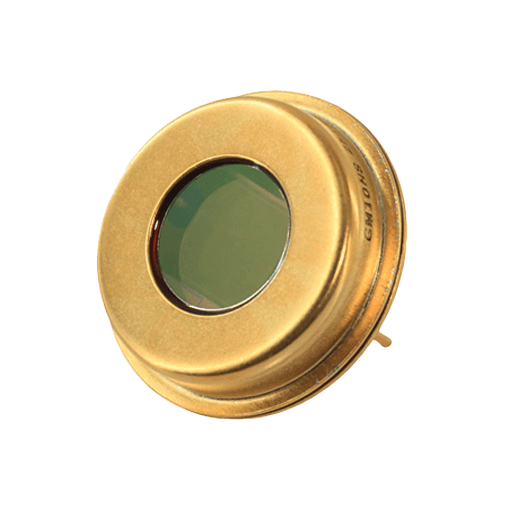
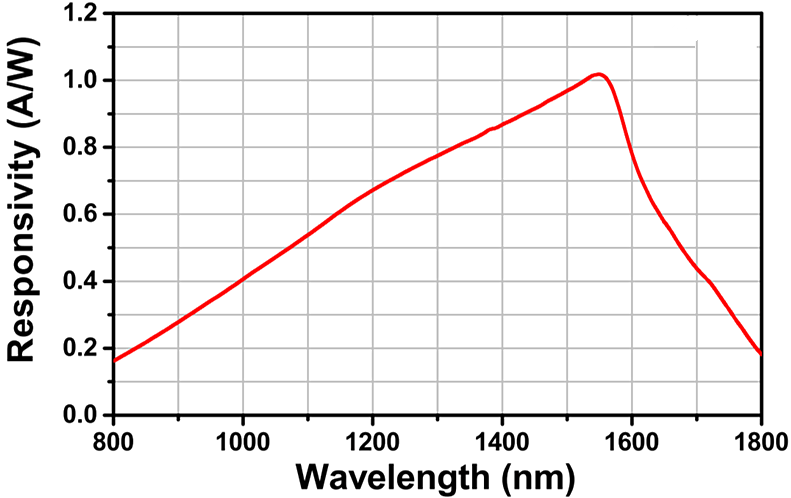
10×10 photodiode is ideal for measuring both pulsed and CW fiber light sources by converting optical power into electrical current. The detector is ceramic with an anode and cathode. The photodiode anode produces a current, which is a function of the incident light power and the wavelength. The responsivity, Ը(λ), can be read from the plot on the following page to estimate the amount of photocurrent. This can be converted to a voltage by placing a load resistor (RL) from the photodiode anode to the circuit ground. Where P is the power, the output voltage is expressed by 
The bandwidth, fBW, and the rise time response, tR, are determined from the diode capacitance, CJ, and the load resistance, RL, as shown below. The diode capacitance can be lowered by placing a bias voltage from the photodiode cathode to the circuit ground.

-
Features
- Large active area (10mm×10mm)
- Low PDL
-
Applications
- Power meter
- Fiber sensor
-
Specifications
| Part number | GE10X10-TO9 |
| Key Feature | Largest Active Area |
| Sensor Material | Ge |
| Wavelength Range | 800 - 1800nm |
| Active Area | 100 mm2 (10 mm×10 mm) |
| Rise/Fall Timeb | 10 μs (Typ.) @ 1 V |
| NEP | 4.0 x 10⁻¹² W/Hz1/2 @ 1550 nmc |
| Dark Current | 50 µA (Max) @ 0.3 V |
| Junction Capacitance | 80 nF (Typ.) @ 1 V 135 nF (Typ.) @ 0 V |
| Shunt Resistance | 2 kΩ (Min) |
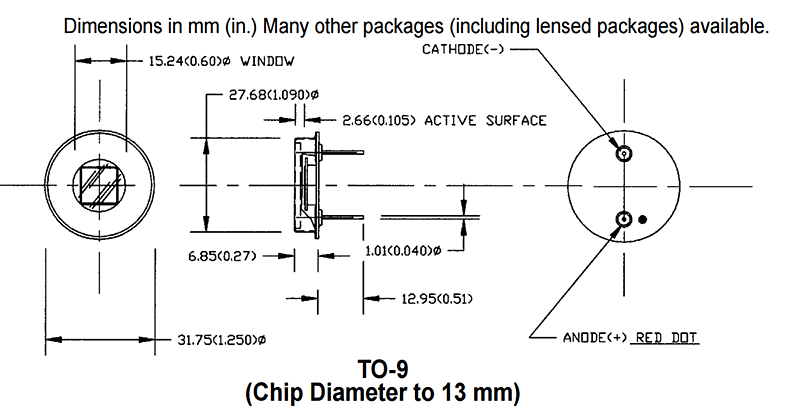
| Package | TO9 Package |
-
Spectral response
The responsivity of a photodiode is a measure of its sensitivity to light and is defined as the ratio of the photocurrent IP to the incident light power P at a given wavelength: 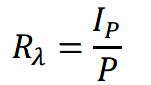
In other words, it is a measure of the effectiveness of the conversion of light power into electrical current. Responsivity varies from lot to lot and with the wavelength of the incident light, applied reverse bias, and temperature. It increases slightly with applied reverse bias due to improved charge collection efficiency in the photodiode. An increase or decrease in the temperature changes the width of the band gap, which will vary inversely with the temperature change.
In other words, it is a measure of the effectiveness of the conversion of light power into electrical current. Responsivity varies from lot to lot and with the wavelength of the incident light, applied reverse bias, and temperature. It increases slightly with applied reverse bias due to improved charge collection efficiency in the photodiode. An increase or decrease in the temperature changes the width of the band gap, which will vary inversely with the temperature change.
-
Recommended Circuit

-
Diameter